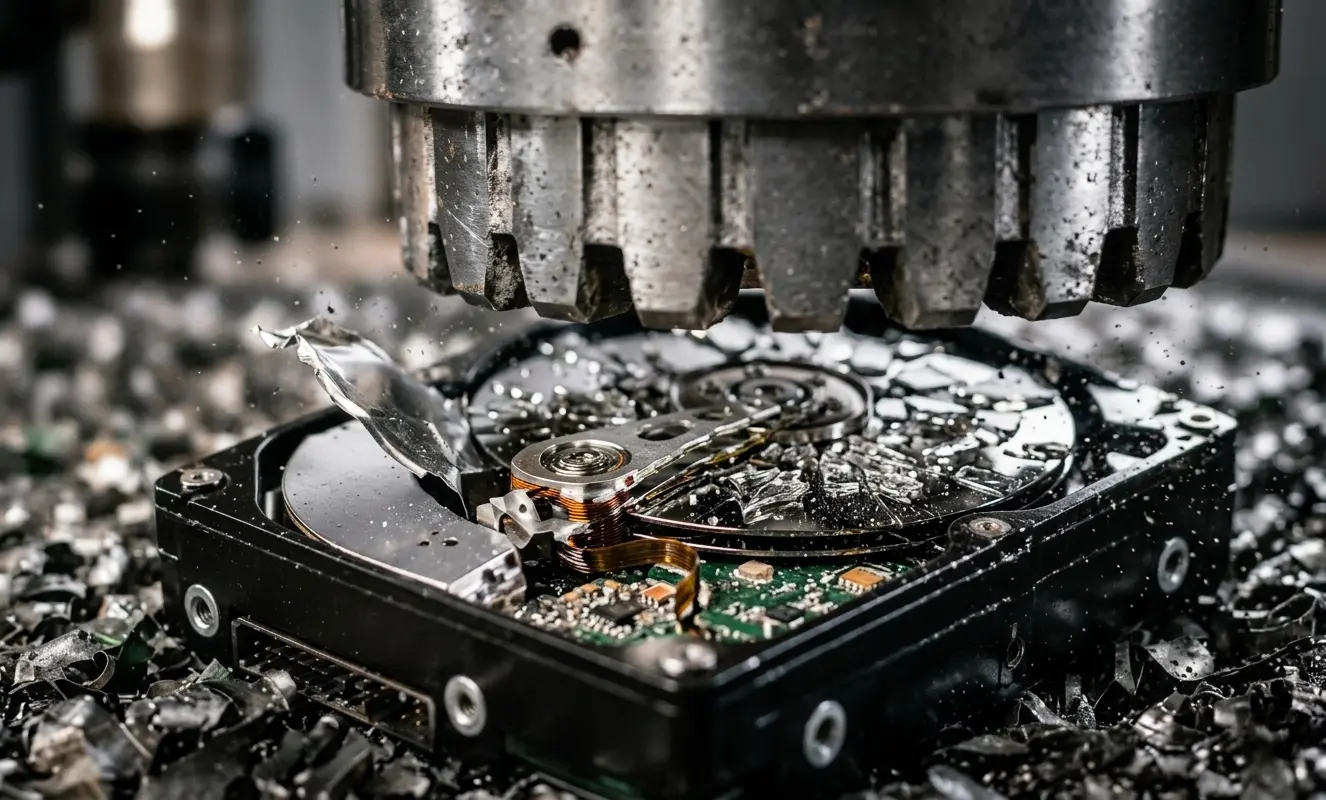
What Is Secure Data Destruction?
Secure data destruction is the process of permanently deleting or destroying data so it cannot be recovered.
It ensures that sensitive information is completely erased from devices before disposal, recycling, or reuse.
In simple terms, deleting files is not enough. When you press “delete,” the data still exists in the background. Secure destruction removes it completely—even from advanced recovery tools.
This process is a critical part of IT Asset Disposition (ITAD), where companies safely manage old or unused IT equipment.
Why Is Secure Data Destruction Important?
Secure data destruction protects your business from data breaches, legal risks, and reputational damage.
Without it, sensitive data can easily fall into the wrong hands.
Here’s why it matters:
- Data breaches are rising: According to IBM, the average cost of a data breach reached $4.45 million in 2023.
- Old devices still contain data: A NAID study found that 40% of used devices still had recoverable data.
- Legal compliance is strict: Regulations like GDPR and HIPAA require proper data disposal.
If data is leaked from discarded devices, companies can face the following:
- Heavy fines
- Loss of customer trust
- Legal consequences
That’s why secure data disposal is not optional—it’s essential.
What Is IT Asset Disposition (ITAD)?
ITAD is the process of safely disposing, recycling, or reusing old IT equipment.
It includes data destruction, asset tracking, and environmental compliance.
Businesses regularly upgrade:
- Laptops
- Servers
- Hard drives
- Mobile devices
Without ITAD, these devices can become a major security risk.
A strong ITAD strategy ensures the following:
- Data is destroyed securely
- Devices are handled responsibly
- Compliance requirements are met
What Are the Most Common Data Destruction Methods?
There are several secure data destruction methods, each designed for different devices and use cases.
The right method depends on data sensitivity, device type, and whether reuse is needed.
Let’s break them down.
1. Data Wiping and Overwriting
Data wiping overwrites existing data with random sequences, making it unreadable.
It is the most common and cost-effective method.
This method:
- Uses software tools
- Writes 1s and 0s over data
- Follows standards like NIST 800-88
👉 Best for:
- Reusing devices
- Selling old hardware
- Internal redeployment
2. Degaussing
Degaussing uses a powerful magnetic field to erase data permanently.
It disrupts the magnetic structure of storage media.
Important facts:
- Works only on magnetic devices (HDDs, tapes)
- Does NOT work on SSDs
- Makes the device unusable
👉 Best for:
- High-security environments
- End-of-life devices
3. Physical Destruction (Shredding)
Physical destruction completely destroys storage devices so data cannot be recovered.
This includes shredding, crushing, or drilling.
This method:
- Destroys hardware physically
- Provides maximum security
- Eliminates reuse value
👉 Best for:
- Highly sensitive data
- Damaged or failed drives
4. Cryptographic Erase
Cryptographic erase deletes encryption keys, making data unreadable instantly.
It is fast but depends on proper encryption.
👉 Best for:
- Encrypted systems
- Modern enterprise environments
5. Built-In Device Sanitization (SSD)
Modern SSDs include built-in secure erase commands.
These are designed specifically for flash storage.
👉 Important:
- SSDs behave differently than HDDs
- Regular wiping may not be effective
Data Wiping vs Physical Destruction: Which Is Better?
Data wiping preserves hardware value, while destruction guarantees maximum security.
The best choice depends on your goals.
| Method | Security | Reuse | Cost |
|---|---|---|---|
| Wiping | High | Yes | Low |
| Destruction | Maximum | No | Higher |
👉 Key Insight:
Many companies unnecessarily destroy devices, losing thousands in resale value.
What Are Data Destruction Standards and Compliance Requirements?
Data destruction standards ensure that data is erased securely and legally.
Following them protects your business from fines and risks.
Key Standards:
- NIST SP 800-88 – Recommended by the U.S. government
- DoD 5220.22-M – Military-grade wiping method
- GDPR – Data protection law in Europe
- HIPAA – Healthcare data protection
👉 Fact:
Regulators don’t just ask “Did you delete data?”
They ask: “Can you prove it?”
What Is a Certificate of Data Destruction?
A Certificate of Data Destruction is proof that your data was securely erased or destroyed.
It is essential for audits and compliance.
It typically includes:
- Device serial numbers
- Destruction method
- Date and time
- Technician details
Without this certificate, your business remains exposed.
What Is Chain of Custody in Data Destruction?
Chain of custody tracks the movement of devices from collection to destruction.
It ensures no data is lost, stolen, or accessed during the process.
This includes:
- Secure transportation
- Controlled handling
- Audit logs
👉 This is critical for compliance and legal protection.
Common Mistakes in Data Disposal (And How to Avoid Them)
Most businesses think deleting files or factory resetting devices is enough—it’s not.
These mistakes can lead to serious data breaches.
❌ Mistake 1: Deleting Files Only
✔ Fix: Use certified data wiping tools
❌ Mistake 2: Factory Reset
✔ Fix: Perform verified data sanitization
❌ Mistake 3: Throwing Devices Away
✔ Fix: Use professional ITAD services
❌ Mistake 4: No Documentation
✔ Fix: Always get a destruction certificate
Best Practices for Secure Data Destruction
Following best practices ensures your data remains protected and compliant.
✔ Create a Data Disposal Policy
Define clear rules for handling old devices
✔ Classify Data Sensitivity
Not all data needs the same level of security
✔ Choose the Right Method
Match method to device type
✔ Work with Certified Vendors
Look for R2, ISO, or NAID certifications
✔ Maintain Records
Always document the process
Why Businesses Should Use Professional ITAD Services
Professional ITAD providers ensure secure, compliant, and efficient data destruction.
They reduce risk while saving time and resources.
Benefits include:
- Certified processes
- Audit-ready documentation
- Secure logistics
- Environmental compliance
👉 Real-world example:
Morgan Stanley was fined $35 million due to improper data disposal.
That’s the cost of doing it wrong.
How Secure Data Destruction Supports Sustainability
Secure data destruction doesn’t mean destroying everything.
Smart businesses focus on reuse and recycling.
Benefits:
- Reduces e-waste
- Saves costs
- Supports ESG goals
👉 Fact:
The world generates over 50 million tons of e-waste annually (Global E-waste Monitor).
Reusing devices after secure wiping helps reduce this.
Final Thoughts: Secure Data Destruction Is a Business Necessity
Secure data destruction is not just an IT task—it’s a business risk strategy.
Done right, it protects data, ensures compliance, and saves money.
The key takeaway:
- Wipe when you can
- Destroy when you must
- Always verify and document
If your business handles sensitive data (and it does),
Then secure data disposal is something you cannot ignore.
STAY IN THE LOOP
Subscribe to our free newsletter.
Leave A Comment
Related Posts
- What assets were collected?
- Who collected them?
- When were they picked up?
- Were the devices data-bearing?
- What data destruction method was used?
- Was each device tracked by serial number or asset tag?
- Was the equipment recycled, destroyed, resold, or remarketed?
- Was a Certificate of Destruction issued?
- Is there a complete chain of custody?
- Asset inventory report
- Serial numbers
- Asset tags
- Pickup date
- Processing date
- Data destruction method
- Final disposition
- Chain of custody record
- Certificate of Destruction
- Recycling or remarketing record, if applicable
- Device type
- Make and model
- Serial number
- Asset tag
- Quantity
- Condition
- Department or location, if available
- Pickup confirmation
- Driver or technician information
- Asset transfer details
- Transportation record
- Processing facility record
- Data destruction confirmation
- Final disposition status
- Hard drive shredding
- SSD destruction
- Data wiping
- Degaussing
- Physical destruction
- Device sanitization
- Match disposed assets with internal IT inventory
- Prove that specific devices were processed
- Track missing or duplicate assets
- Support insurance or compliance reviews
- Answer questions from legal, IT, or management teams
- No serial-number list
- No asset tag matching
- No chain of custody
- Certificate only lists total quantity
- No method of data destruction recorded
- No final disposition status
- No internal approval record
- No record of who released the equipment
- No link between IT inventory and recycling report
- Documentation stored only in emails or scattered folders
- Healthcare clinics and medical offices
- Schools and universities
- Financial services companies
- Law firms
- Oil and gas companies
- Data centers
- Government contractors
- Corporate offices
- Managed service providers
- Warehouses with IT equipment
- Businesses upgrading laptops, servers, or networking devices
- Equipment type
- Quantity
- Location
- Serial numbers, if available
- Asset tags, if available
- Whether devices contain data
- Required destruction method
- Internal contact person
- Any compliance or reporting requirements
- Internal asset retirement
- Sustainability reporting
- E-waste diversion tracking
- Vendor accountability
- Data protection
- Operational cleanup
- Desktop computers
- Laptops
- Workstations
- Servers
- SSDs and Hard drives
- Flat screens and monitors
- Scanners and printers
- Routers and switches
- Networking devices and firewalls
- VoIP phones
- Chargers and cables
- Backup battery for UPS
- Office electronics and projectors
- Mobile devices and tablets
- External storage devices
- Medical clinics, medical offices
- Universities and schools
- Financial companies and banks
- Law firms
- Contractors from the government
- Data centers
- Corporate IT departments
- Companies that handle the records of employees or customers
- Corporate offices are upgrading computers
- Schools replacing classroom technology
- Healthcare facilities that are retiring outdated equipment
- Warehouses clear electronics that are not being used
- IT companies managing client equipment
- Financial institutions and banks getting rid of safe hardware
- Data centers are removing networks and servers
- Retail businesses replacing POS systems
- Public and government sector organisations
Strict adherence to NIST SP 800-88 Rev. 1 and DoD guidelines for absolute data destruction.
Serialized inventory tracking and validation for complete transparency.
Zero-Landfill alignment to ensure all obsolete hardware is recycled responsibly.
Strict adherence to federal, Texas state, and local environmental regulations.
Audit-Ready ITAD Documentation for Houston Businesses: What to Keep Before Recycling IT Assets
When a business retires old computers, servers, hard drives, laptops, networking devices, or data center equipment, the job is not finished when the equipment leaves the building. For Houston companies, the real question is: can you prove what happened to every data-bearing asset after pickup?
That proof is what ITAD documentation is all about.
ITAD, or IT Asset Disposition, is the secure process of retiring, tracking, destroying, recycling, remarketing, or disposing of old technology assets. But during an internal review, client security request, insurance question, data breach investigation, or regulatory audit, a basic pickup receipt is not enough. Businesses need documentation that clearly shows which assets were collected, how they were handled, how data was destroyed, and where each item ended up.
For Houston businesses handling customer information, employee records, financial data, health records, contracts, or internal systems, audit-ready ITAD documentation can protect the company from risk long after the equipment is gone.
Houston United Computer Recycling provides IT asset disposition services for businesses that need a secure and responsible way to manage retired IT equipment, data-bearing devices, and business electronics.
Why ITAD Documentation Matters During an Audit
Audits are not only about financial records. Many organizations are now expected to show how they manage data, hardware, vendor risk, and end-of-life technology. If old devices are recycled without clear records, a business may struggle to prove that sensitive data was protected.
Good ITAD documentation helps answer important questions:
Without these records, a company may have a gap between its internal IT inventory and what actually happened during disposal. That gap can become a serious issue during an audit or investigation.
A Certificate of Destruction Alone May Not Be Enough
A Certificate of Destruction is important, but it should not be the only document a business keeps.
A simple certificate that says “assets destroyed” may confirm that a service was performed, but it does not always prove what happened at the asset level. For stronger documentation, the certificate should be supported by detailed records.
A more complete ITAD file should include:
The stronger the records, the easier it is for IT, finance, compliance, and leadership teams to answer questions later.
What Audit-Ready ITAD Documentation Should Include
Audit-ready ITAD documentation should be specific, organized, and easy to match against your internal records. It should not be vague or only based on total quantity.
For example, this is weak documentation:
“50 laptops recycled.”
This is stronger documentation:
“50 laptops collected from Houston office on a specific date, listed by serial number and asset tag, with data destruction method, processing result, and final disposition recorded for each device.”
That second version gives your organization a clear record. It also helps reduce confusion if one device later appears in an internal audit, vendor review, insurance claim, or data security question.
ITAD Audit Documentation Checklist
Before closing an ITAD project, Houston businesses should try to keep the following documents:
1. Pickup or Collection Record
This confirms when the equipment was collected, from which location, and by whom. It should include the business name, pickup address, date, and basic item count.
2. Asset Inventory Report
This report should list each item collected. Useful fields include:
3. Chain of Custody Record
Chain of custody shows how assets moved from your business to the ITAD provider and through final processing. It creates accountability between pickup, transportation, storage, data destruction, recycling, and final disposition.
4. Data Destruction Certificate
This document confirms that data-bearing assets were destroyed or sanitized. For stronger records, it should identify the devices and method used.
Houston United Computer Recycling provides secure data destruction services for businesses that need hard drive shredding, data wiping, or other secure destruction options.
5. Sanitization or Wiping Report
If devices are wiped instead of physically destroyed, the report should show the method used, verification result, and device-level status.
6. Final Disposition Report
This explains what happened after processing. Devices may be recycled, remarketed, refurbished, donated, or destroyed depending on condition, data sensitivity, and business requirements.
7. Recycling or Environmental Documentation
For companies with sustainability reporting goals, recycling records can support internal environmental reports and e-waste diversion tracking.
Chain of Custody: The Core of ITAD Compliance
Chain of custody is one of the most important parts of ITAD documentation. It shows that assets were not simply removed from the office and forgotten. Instead, each stage is documented.
A good chain of custody record may include:
This matters because many business electronics contain sensitive data. Hard drives, SSDs, laptops, servers, tablets, backup devices, and some printers may store recoverable information. If these items are not tracked properly, the business may not know whether data was safely handled.
Data Destruction Records: Shredding, Wiping, and Sanitization Proof
Not every asset requires the same data destruction method. Some devices may need physical hard drive shredding. Others may be wiped or sanitized if they are being remarketed or reused.
Common methods include:
The right method depends on the type of device, the sensitivity of the data, internal company policy, and whether the asset has resale value.
For businesses in healthcare, finance, legal, education, oil and gas, government contracting, and enterprise IT, data destruction records should be treated as part of the company’s risk management process.
Asset-Level Reporting: Why Serial Numbers Matter
A strong ITAD report should not only list total quantities. It should identify individual assets whenever possible.
Serial-number-level reporting helps businesses:
For example, if a laptop serial number appears in an audit six months after recycling, your team should be able to search the ITAD record and confirm exactly what happened to that device.
That is why asset-level reporting is much stronger than a generic bulk recycling receipt.
Common ITAD Documentation Gaps That Create Audit Risk
Many businesses do the right thing by recycling old electronics, but they still leave documentation gaps.
Common issues include:
These gaps may not matter on the day of pickup, but they can become painful later when a compliance officer, auditor, client, or legal team asks for proof.
Which Houston Businesses Need Strong ITAD Records?
Any business with data-bearing devices should care about ITAD documentation. But some organizations need stronger records because of the type of data they handle.
These include:
If your company handles customer records, employee data, payment information, medical records, contracts, or internal business systems, documentation should be part of your disposal process.
How to Prepare Before Scheduling an ITAD Pickup
Before scheduling a pickup, your business should prepare a basic asset list. This helps the ITAD provider understand the scope and helps your team keep cleaner records.
Before pickup, try to collect:
You can also review the items accepted for recycling before scheduling. If your company has computers, laptops, servers, hard drives, monitors, printers, or networking devices ready for disposal, you can schedule a pickup or request a quote.
How ITAD Documentation Supports Electronics Recycling
ITAD documentation is not only about data security. It also supports responsible electronics recycling in Houston.
When a business has clear records, it can understand which assets were destroyed, which were recycled, and which may have been recovered for value. This helps with:
For companies retiring large volumes of equipment, documentation creates a clean bridge between IT, finance, compliance, and environmental responsibility.
Final Thoughts: Do Not Wait for an Audit to Organize ITAD Records
The best time to think about ITAD documentation is before equipment leaves your facility. Once assets are gone, it becomes harder to rebuild accurate records.
Audit-ready ITAD documentation gives Houston businesses confidence that retired IT assets were handled securely, responsibly, and with clear accountability. A Certificate of Destruction is useful, but it should be part of a larger record that includes asset inventory, chain of custody, data destruction method, and final disposition.
If your business is preparing to recycle computers, servers, hard drives, laptops, or other IT equipment, Houston United Computer Recycling can help you plan a secure and documented process from pickup to final disposition.
Contact Houston United Computer Recycling today to discuss ITAD documentation, secure data destruction, and business electronics recycling in Houston.
FAQs About ITAD Documentation
What is ITAD documentation?
ITAD documentation is the set of records that proves how retired IT assets were collected, tracked, processed, destroyed, recycled, or remarketed. It may include asset inventory, chain of custody, data destruction certificates, serial numbers, and final disposition reports.
Is a Certificate of Destruction enough for an audit?
A Certificate of Destruction is important, but it may not be enough by itself. Businesses should also keep asset-level reports, chain of custody records, and data destruction method details.
What should be included in an ITAD audit checklist?
An ITAD audit checklist should include pickup records, asset inventory, serial numbers, asset tags, chain of custody, data destruction certificate, sanitization report, and final disposition documentation.
Why are serial numbers important in ITAD reports?
Serial numbers help match disposed assets with internal inventory records. They also help prove that a specific device was collected, processed, and destroyed or recycled.
What is chain of custody in ITAD?
Chain of custody is the documented record of how IT assets move from pickup through transportation, processing, data destruction, recycling, and final disposition.
Do Houston businesses need ITAD documentation?
Yes. Any Houston business that disposes of data-bearing equipment should keep ITAD documentation, especially healthcare, finance, education, legal, oil and gas, government, and corporate IT organizations.
How can I schedule documented ITAD pickup in Houston?
You can schedule a pickup through Houston United Computer Recycling and share your equipment list, location, quantity, and data destruction requirements before the pickup.
📞 Call 832-613-8657 | Free ITAD Assessment for Houston Businesses | Same-Day Quote Available
Visit: houstonunitedcomputer.com or call us today to schedule your free commercial e-waste pickup.
Our Services: IT Asset Disposition | Data Destruction | Electronics Recycling | Data Center Decommissioning | Asset Recovery
Free E-Waste Pickup in Houston: What Businesses Can Recycle and How to Schedule It
Companies in Houston depend on technology each and daily. From desktop computers and laptops to printers, servers and monitors, network devices and storage drives, electronic devices keep offices, schools, health facilities warehouses, corporate teams in good shape. When the equipment is damaged, outdated or is replaced in the course of an IT upgrading, it swiftly transforms into the e-waste.
Older electronics should not be stored in storage spaces for a long time, and should not be disposed of in the regular garbage. Business electronics could contain sensitive company information such as employees’ records, customer records passwords, financial files, financial documents and other personal information. They also may contain elements that require to be handled with care. This is the reason why working with an experienced recycling company for electronics is essential.
Houston United Computer Recycling provides electronics recycling in Houston for businesses that need a secure, simple, and responsible way to recycle retired IT equipment. With free e-waste collection options for businesses that meet the requirements, businesses can get rid of old equipment with no disruption to daily routines.
Why Businesses Need E-Waste Pickup in Houston
A lot of companies store old electronic devices due to the fact that they don’t know where to send them, or what to do with them. A closet full of empty laptops, desktops monitors, servers and hard drives might appear safe, but they could cause business risk over the course of time.
The primary concern is security of the data. Even if the device no is working the internal or hard drive storage might still contain information that can be recovered. This is crucial for companies working that deal in finance, healthcare and legal services, education as well as government contracting and other fields that deal with confidential data.
The second concern is space. old electronics occupy important office, warehouse as well as IT space. When businesses upgrade their equipment or relocate their places, or even close down departments, the unused equipment can accumulate quickly.
The third aspect is the responsible disposal. Recycling electronics helps companies avoid the waste of landfill and encourages an environmentally sustainable approach to the disposal of old equipment. A reliable recycling company can help separate recyclable equipment from non-working ones as well as recover the value whenever feasible, and reuse the other materials in a sustainable procedure.
What Business Electronics Can Be Recycled?
Houston businesses are able to recycle a range of IT items and office equipment. Some of the most popular items include:
Before scheduling a pickup, businesses should review the full list of items accepted for electronics recycling. This can help identify which gadgets are eligible and if specific handling is needed.
For companies with large quantities of retired IT equipment, recycling can also be combined with IT asset disposition services. ITAD is especially beneficial for businesses that require asset tracking in value recovery, secure disposal, as well as documents that are audit-ready.
Is E-Waste Pickup Free in Houston?
E-waste pickup is free to businesses that are eligible located in Houston and the surrounding regions. In the majority of cases, free pickup is dependent on the size of items, the type, and the quality of the item. Items that are business-grade like desktops laptops, laptops and servers, routers, switches, printers projectors, LCD monitors are typically more suitable to be picked up than smaller electronic devices used in the home.
For instance, a business getting rid of 10 or more electronics that are business-grade might be eligible for a pickup, and certain products such as CRT monitors household electronics, CRT monitors and batteries that are not in good condition, as well as small-quantity pickups might require a review prior to their evaluation.
The most effective method of confirming the eligibility of your equipment is to call Houston United Computer Recycling and give a short list of the equipment you have. Include photos of the items, their quantities, as well as your location for business to help facilitate the process of quoting and scheduling easier.
If your business is ready to clear out old electronics, you can schedule a free e-waste pickup and let the team confirm the next steps.
Why Data Destruction Matters Before Recycling
The most significant aspects of recycling electronics for business is the protection of data. Laptops, computers servers, servers printers, storage arrays as well as some office equipment may have data-bearing media. Just deleting or resetting the device may not be enough for a secure removal.
Companies should ensure that important data is destroyed safely erased prior to the time equipment is recycled, resold or used again. Houston United Computer Recycling provides secure data destruction and hard drive shredding options to help companies protect confidential information.
Methods for data destruction could include shredding of hard drives and data erasure degaussing or physical destruction, based on type of device, the data sensitivity and the company’s requirements. For companies that require verification that they have serialized tracking, Certificates of Destruction can help aid in internal audits, records and compliance processes.
This is crucial because:
Secure recycling is not only about getting rid of old equipment. It’s about defending your company from exposure to data and ensuring that every device is managed with integrity.
How the E-Waste Pickup Process Works
It is easy to schedule e-waste pickup once you have your details for the equipment. Here’s a common procedure for Houston companies:
1. Prepare Your Equipment List
Make an inventory of the items you’d like to reuse. Include items in terms of quantities and kinds, like 20 laptops 15 desktops, 15 desktops, 5 servers, 10 screens and 30 or more hard disks. If you are able you can separate devices that carry data from other electronic devices.
2. Submit a Pickup Request
Utilize the form on the website to make a request for pickup. You can include your name, number, email address, company names, the pickup location and a brief description of the equipment. Businesses can also contact Houston United Computer Recycling directly for questions.
3. Confirm Eligibility
The team examines your list of items, the number of items, and location to determine if your pickup is eligible for free. If certain items require specific handling, you’ll be given advice prior to making your appointment.
4. Schedule a Convenient Pickup Time
If your request is accepted After approval, pickups are timed according to your company’s availability. This will reduce the disruption to your warehouse, office or school team.
5. Secure Collection and Transport
Your electronic devices are gathered and then transported to be processed. In the case of IT-related assets securing handling practices and chain-of-custody procedures aid in keeping equipment organized throughout the process.
6. Data Destruction and Recycling
Devices that store data are safely erased or destroyed according to the method chosen. Equipment that is reuseable can be analyzed to be resold or repaired and non-working electronic devices are recycled in a responsible manner.
7. Documentation When Needed
Businesses that require proof can need documentation like Asset reports or Certificates of Destruction. This can help support internal records, compliance and auditing requirements.
Who Benefits from a Business E-Waste Collection?
The free pickup of e-waste is beneficial for various types of organizations in Houston such as:
If your company has some old laptops or a whole room filled with retired IT assets, a reliable recycling partner can make the process more secure and more efficient.
Areas Served Around Houston
Houston United Computer Recycling provides support to businesses throughout Houston and the surrounding regions. The areas of service comprise Houston, Stafford, Sugar Land, Katy, Missouri City, Pearland, Richmond, Energy Corridor, and the surrounding areas.
If your company isn’t in the primary Houston region, you may still make a request for pickup and confirm the availability of pickups based on your location and the quantity of equipment.
Schedule Your Free E-Waste Pickup in Houston
Business electronics that are no longer in use should not be kept in storage for too long and shouldn’t be destroyed without adequate data security. With a professional service for e-waste collection companies can free up space, safeguard sensitive information recycling responsibly, and handle the disposal of retired IT assets in confidence.
If your company is equipped with computers servers, laptops, laptops monitors, hard drives printers, network equipment that can be recycled, Houston United Computer Recycling can assist.
Schedule your free e-waste pickup in Houston today or request a quote to confirm pickup eligibility, accepted items, and secure data destruction options.
FAQs About Free E-Waste Pickup in Houston
Do you pick older computers that you find in Houston companies?
Yes, businesses that meet the requirements can arrange for pickup of old laptops, computers and servers, monitors and printers, networking equipment and other electronic devices that have been approved.
Is e-waste for business pickup always cost-free?
Free pickup typically depends on the type of item, its the quantity, location and the qualification requirements. It is recommended to send your list of items first so that the team can verify.
Do hard drives have the ability to be destroyed prior to recycling?
Yes. Businesses are able to request shredding of hard drives data eraser degaussing, and other options for secure destruction of data prior to recycling or reselling equipment.
What kinds of items can be recycled?
The most commonly accepted items are laptops, desktops, servers hard drives, monitors printers, routers switches and projectors, firewalls, phones, tablets and office electronic devices. Review the full items accepted list for details.
How do I arrange for the pickup of e-waste?
You can submit a request through the Schedule a Pickup page or contact the team directly with your equipment list, quantity, location, and preferred pickup time.
📞 Call 832-613-8657 | Free ITAD Assessment for Houston Businesses | Same-Day Quote Available
Visit: houstonunitedcomputer.com or call us today to schedule your free commercial e-waste pickup.
Our Services: IT Asset Disposition | Data Destruction | Electronics Recycling | Data Center Decommissioning | Asset Recovery
ITAD Isn’t a Recycling Decision. It’s a Risk Reduction & Brand Protection Decision.
Corporate hard drives with recoverable data have been sold on eBay. Containers of e-waste have washed up on international shorelines and been traced back to U.S. companies. In every case, the liability didn’t fall on the vendor who mishandled the assets. It fell squarely on the company whose name was still on the data.
These aren’t failures of rogue operators. They’re symptoms of how the ITAD industry actually works. The standard practice — even among certified vendors — is to collect assets and send them downstream to third-party processors for destruction and material recovery. It’s legal, it’s common, and it’s how the vast majority of ITAD companies operate.
At Houston United Computer Recycling, we don’t think that’s good enough. Not for our clients, and not for the data they’re trusting us to destroy. So we built something different.
Where Does Corporate Liability Risk Actually Enter Your ITAD Program?
Even well-run ITAD programs can carry risks that are not obvious from the outside. The contracts look solid. The SLAs are in place. There’s a certificate of destruction at the end. But the distance between what’s documented and what’s actually happening is often wider than most companies realize.
Do Most ITAD Vendors Actually Process E-Waste Themselves?
Most don’t — and that’s not a secret the industry hides. It’s simply how the business is structured. The majority of ITAD vendors in the United States are logistics and brokerage operations. They pick up your equipment and send it to third-party processors for destruction and material recovery, sometimes through two or three intermediaries. It’s accepted practice. It’s how certified companies operate.
But every handoff in that chain is a point where your visibility ends and your exposure begins. Most clients never realize their assets are passing through multiple facilities and multiple sets of hands, because the paperwork that comes back looks the same either way.
Houston United exists because we believe corporations deserve to know exactly what happens to their assets — not just trust that someone in the chain of custody handled it.
What Happens When Data Destruction Is Outsourced?
When data destruction is outsourced — even by a reputable ITAD vendor — your vendor is issuing a certificate based on what they’ve been told happened, not what they witnessed or controlled. That certificate documents a report from a third party, not a verified outcome under your vendor’s roof.
Your drives are being handled by workers your vendor didn’t hire, in a facility your vendor may never have visited, under processes your vendor doesn’t manage day to day. This doesn’t make your vendor negligent. It makes them normal. But normal isn’t the same as secure.
For companies in regulated industries — healthcare, financial services, energy, government contracting — this matters more than most realize. Data handling obligations under HIPAA, GLBA, SOX, and state-level privacy regulations don’t end when hardware leaves your server room. The obligation to protect that data follows the data itself, regardless of how many vendors touch it along the way.
Does a Certificate of Destruction Actually Protect My Company?
A certificate of destruction is only as reliable as the process behind it. If your vendor collected your assets, shipped them to a downstream processor, and received confirmation that destruction occurred, that certificate reflects a chain of reports — not a chain of custody your vendor personally controlled.
Regulatory bodies and auditors are increasingly scrutinizing this difference. In the event of a data breach tied to improperly disposed assets, a certificate from a vendor who outsourced the actual destruction may not provide the legal protection most companies assume it does.
That’s where risk quietly enters the system. Not through negligence, but through an industry structure that treats indirect oversight as good enough.
Can Improper ITAD Create Regulatory Risk for Your Organization?
Absolutely. When retired IT assets aren’t handled under a verified, controlled chain of custody, the regulatory exposure is real — and it extends well beyond data privacy. Environmental regulations like RCRA and international frameworks govern how electronic waste is transported and processed. Noncompliant disposal can trigger EPA enforcement actions, state-level penalties, and reputational damage that no compliance report can undo.
The risk isn’t limited to what’s on the hard drive. It’s in the entire lifecycle of the asset after it leaves your facility. If you can’t verify where it went and what happened to it at every stage, you have a gap in your compliance posture — whether you know it or not.
We Don’t Ask Clients to Trust What They Can’t See.
The industry standard works for most vendors. It doesn’t work for us. We built Houston United around a simple principle: if a client can’t verify what happened to their assets, then the process isn’t actually secure — it’s just convenient.
What Does Fully In-House ITAD Processing Look Like?
Everything — data destruction, electronics shredding, and material recovery — happens right here at our secure tech facility in Stafford, Texas. Houston United is structured to process assets with a hyper-focused local chain of custody. From the moment we pick up your assets to the final stage of disposition, the chain of custody has one direct link: us.
Every hard drive is serialized, tracked, and documented. Every process stage is audit-ready. Our facility operates under strict access control, background-checked staff, and detailed monitoring protocols. We don’t hand your assets to someone else downstream and hope for the best. We handle them ourselves and prove it.
This isn’t about pointing fingers at the rest of the industry. It’s about choosing to operate at a standard that gives our clients something most brokerage ITAD programs can’t: complete visibility from pickup to final disposition.
What Certifications Reduce Regulatory Risk?
The standards that matter most to enterprise buyers fall into data security, environmental compliance, and quality management. Our processes focus heavily on compliance protocols because they represent the level of accountability we think every client deserves during vendor reviews:
Data Security & Compliance
Quality & Environmental Management
Why Do Companies Choose Houston United to Reduce Corporate Liability?
Because they’re looking for a risk-management partner, not just a recycler. Our clients come to us because they’ve looked under the hood of the standard ITAD model and decided they need something more accountable. They need to know exactly what happens to every asset, at every stage, with documentation that can withstand a strict audit — not just satisfy a checklist.
That’s what a direct, zero-downstream model gives them. Complete control. Complete visibility. No room for assumptions. Our partners view us as an extension of their own risk management, because that’s exactly what we are.
Circularity Isn’t a Marketing Word. It’s a Risk Reduction Strategy.
There’s a growing conversation in boardrooms about circularity, sustainability, and responsible disposal. These are important goals — and we take them seriously. But too often, “circularity” gets applied as a label to programs where materials disappear into opaque downstream channels and no one can say exactly where they ended up. That’s not circularity. That’s hope.
What Does Real Circularity Look Like in ITAD?
Circularity only works when reuse, destruction, and material recovery are all transparent and controlled. At Houston United, our approach follows a clear hierarchy: reuse first, controlled destruction when reuse isn’t viable, and responsible material recovery for everything else.
When assets arrive at our facility, we assess every piece of equipment for refurbishment and remarketing potential. Hardware that still has functional life gets a second one — securely wiped, tested, and made available for resale. This isn’t just an environmental win. It’s a value recovery opportunity for our clients, returning revenue from assets that would otherwise be written off entirely.
Sustainability isn’t a slogan for us. Shredding is calculated. Reuse comes first. We control the process. And when materials are recovered, we know exactly where they go — because they are managed under our direct oversight.
Your Brand Is Only as Secure as Your ITAD Partner.
The ITAD industry operates the way it operates for understandable reasons — scale, cost efficiency, logistics. We’re not here to say the entire industry is broken. We’re here to say that for companies whose data, compliance obligations, and brand reputation are on the line, the standard approach leaves gaps that don’t have to exist.
The companies that get this right aren’t the ones who found the cheapest pickup service. They’re the ones who asked harder questions: Who actually destroys our drives? Where does our equipment physically go? Can we verify every step, or are we relying on someone else’s word?
Houston United was built to answer every one of those questions with complete transparency. One local facility. One verified chain of custody. Certified data destruction. Documented at every stage. Audit-ready from day one.
We help companies close the gap between what they assume is happening with their retired IT assets and what’s actually provable. No outsourced data destruction. No opaque downstreams. No distance between what we promise and what we show you.
So you can sleep at night.
📞 Call 832-613-8657 | Free ITAD Assessment for Houston Businesses | Same-Day Quote Available
Visit: houstonunitedcomputer.com or call us today to schedule your free commercial e-waste pickup.
Our Services: IT Asset Disposition | Data Destruction | Electronics Recycling | Data Center Decommissioning | Asset Recovery
How AI Upgrades Are Forcing Houston Businesses into Faster IT Asset Disposition (ITAD)
AI is changing how fast Houston businesses replace their technology and it is happening quicker than most IT teams expected. Servers that used to last five or six years are now being retired in two or three. GPUs that were cutting-edge last year are already outdated. And the equipment piling up in storage closets across Houston is no longer just old laptops it is racks of decommissioned servers, networking gear, and storage systems that all carry sensitive company data.
This shift is creating real urgency around IT asset disposition (ITAD). Businesses that used to plan disposal once a year are now dealing with it every quarter. If your company is in the middle of an AI-driven hardware refresh, here is what you need to know and why a certified ITAD partner in Houston matters more now than ever.
Why AI Is Accelerating Hardware Refresh Cycles
AI workloads demand more processing power, more memory, and more specialized hardware than traditional business computing ever did. GPUs designed for AI training become outdated within 18 to 24 months as newer, faster chips arrive. Storage systems need to handle massive data sets at speeds older infrastructure simply cannot support.
This is not just a data center problem. Houston is already one of the fastest-growing data center markets in Texas, with the state housing nearly 400 operating data centers as of late 2025. As AI adoption grows locally, the pressure to upgrade infrastructure faster is spreading from large data centers into mid-size businesses, healthcare systems, and corporate IT departments across the city.
The result: hardware refresh cycles that used to take five years now happen in two to three. That means more retired equipment, more often and a growing need for fast, secure, and compliant disposal.
What AI Upgrades Mean for Houston Businesses
For Houston IT managers and business owners, AI adoption is not optional anymore competitors are already using it to automate operations, improve customer service, and analyze data faster. That means more companies across Houston are deploying AI servers, GPU workstations, and upgraded networking equipment to keep up.
But every upgrade creates a disposal problem. The old servers, the retired GPU workstations, the previous-generation storage arrays all of it needs to go somewhere. And increasingly, businesses are realizing that simply storing this equipment in a back room is not a real solution. It ties up space, creates security risk, and delays the value recovery that retired equipment can still provide.
The Growing Need for Faster IT Asset Disposition
Traditional ITAD planning assumed equipment retirement happened occasionally. AI has broken that assumption. Houston businesses now need IT asset disposition services that can respond on a rolling basis not just once a year during a budget cycle.
This is where many companies fall behind. They have a process for disposing of laptops but no clear plan for retiring AI servers, GPU clusters, or networking infrastructure at the pace AI upgrades demand. Without a fast, repeatable ITAD process, equipment backs up, data security risk increases, and asset value is lost to depreciation.
A reliable IT asset disposition company should be able to handle recurring pickups, scale with your refresh schedule, and process everything from a handful of old laptops to a full rack of decommissioned servers.
Data Security Risks During AI-Driven Upgrades
AI servers and GPU workstations often store more sensitive data than typical office computers training data, customer records, proprietary models, and business intelligence. When this equipment is retired quickly and in volume, the risk of improper disposal grows.
Simply deleting files or wiping a drive with a factory reset is not enough. Data recovery tools can pull supposedly deleted information off drives that were not properly sanitized. For Houston businesses in healthcare, finance, energy, and legal services, this creates serious exposure HIPAA violations, regulatory fines, and reputational damage if retired hardware ends up in the wrong hands.
Secure IT asset disposition means certified data destruction NIST SP 800-88 compliant wiping or physical destruction of drives with documented proof for every device. That documentation is what protects your business if a compliance audit or legal question ever comes up later.
Asset Recovery Opportunities from Retired Equipment
Here is the part many Houston businesses overlook: retired AI hardware often still has resale value. GPUs, servers, and networking equipment that are no longer suited for AI workloads can still be functional for less demanding use cases, and certified ITAD providers can refurbish, remarket, or buy back this equipment.
An IT asset buyback program turns what looks like a disposal cost into a partial return on investment. Instead of treating retired servers as pure expense, businesses can recover value that offsets the cost of new AI infrastructure while still meeting full data security and compliance requirements before any resale happens.
Sustainability and E-Waste Reduction Benefits
Faster refresh cycles mean more electronic waste, and Houston is already generating significant volumes of retired IT equipment every year. Certified electronics recycling keeps servers, GPUs, and networking hardware out of landfills, recovers valuable materials, and supports a circular economy approach to enterprise technology.
For Houston businesses tracking ESG goals, partnering with a certified ITAD and e-waste recycling provider gives you real, documented environmental impact data not just good intentions. Every device processed responsibly is one less piece of e-waste contributing to landfill toxins like lead and mercury.
Why Houston Businesses Should Partner with a Local ITAD Provider
National ITAD brokers can handle volume, but local providers understand the pace of Houston’s market and can respond faster. Houston United Computer Recycling works directly with Houston businesses, data centers, and IT departments managing AI-driven refresh cycles offering scheduled pickups, certified data destruction, electronics recycling, and IT asset buyback under one roof.
Whether you are clearing out a handful of retired laptops or decommissioning a full rack of AI servers, a local Houston ITAD partner means faster turnaround, direct communication, and documentation you can trust for compliance and ESG reporting.
Frequently Asked Questions
IT asset disposition is the secure, documented process of retiring end-of-life IT equipment, including data destruction, asset tracking, and responsible recycling or resale. As AI adoption shortens hardware refresh cycles, ITAD has become critical for Houston businesses retiring servers, GPUs, and networking equipment more frequently than before.
Look for a certified ITAD provider with documented data destruction processes, asset tracking, and local service across Houston. Houston United Computer Recycling provides secure IT asset disposition services with certified data destruction and full documentation for businesses throughout the Houston area.
Without certified data destruction, sensitive data including AI training data, customer records, and proprietary information can potentially be recovered from improperly wiped drives. This creates serious data breach and compliance risk, especially for regulated industries like healthcare and finance.
Many GPUs, servers, and networking devices retired from AI workloads still have resale value for less demanding applications. IT asset buyback programs allow businesses to recover partial value from retired equipment after secure data destruction, offsetting the cost of new infrastructure.
With AI accelerating hardware refresh cycles, many Houston businesses now need ITAD support on a rolling or quarterly basis rather than once a year. Partnering with a local ITAD provider that supports recurring pickups helps keep pace with faster upgrade schedules
Houston businesses and residents can schedule a pickup with a certified electronics recycler like Houston United Computer Recycling, which handles data destruction and responsible recycling for laptops, desktops, and other IT equipment at no cost for qualifying volumes.
📞 Call 832-613-8657 | Free ITAD Assessment for Houston Businesses | Same-Day Quote Available
Conclusion: Keep Pace with AI Without the Disposal Risk
AI is not slowing down, and neither are the hardware refresh cycles it is driving across Houston’s business landscape. Companies that treat IT asset disposition as an afterthought risk data breaches, compliance failures, and lost asset value. Companies that build ITAD into their AI upgrade strategy turn a disposal challenge into a security advantage and a recovery opportunity.
Houston United Computer Recycling provides certified IT asset disposition, secure data destruction, electronics recycling, and IT asset buyback services for businesses across Houston and the surrounding area. Whether you are upgrading a single server room or decommissioning a full AI infrastructure deployment, we make the process fast, secure, and fully documented.
Visit: houstonunitedcomputer.com or call us today to schedule your free commercial e-waste pickup.
Our Services: IT Asset Disposition | Data Destruction | Electronics Recycling | Data Center Decommissioning | Asset Recovery